

Installation image from Memory Fields curated by Sso-Rha Kang
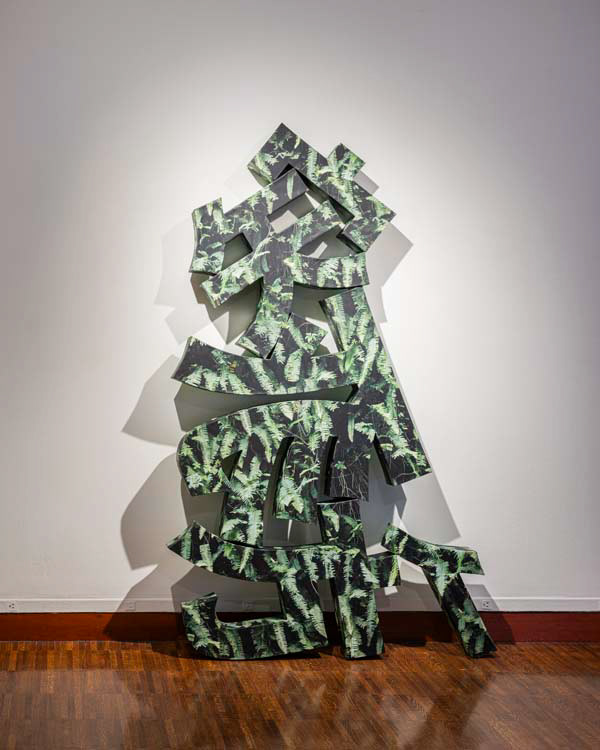
家族 Kazoku, Family, 2024 Wood, printed wall paper, Acrylic Paint

移住, Ijuu, Migration Wood, printed wall paper, Acrylic Paint
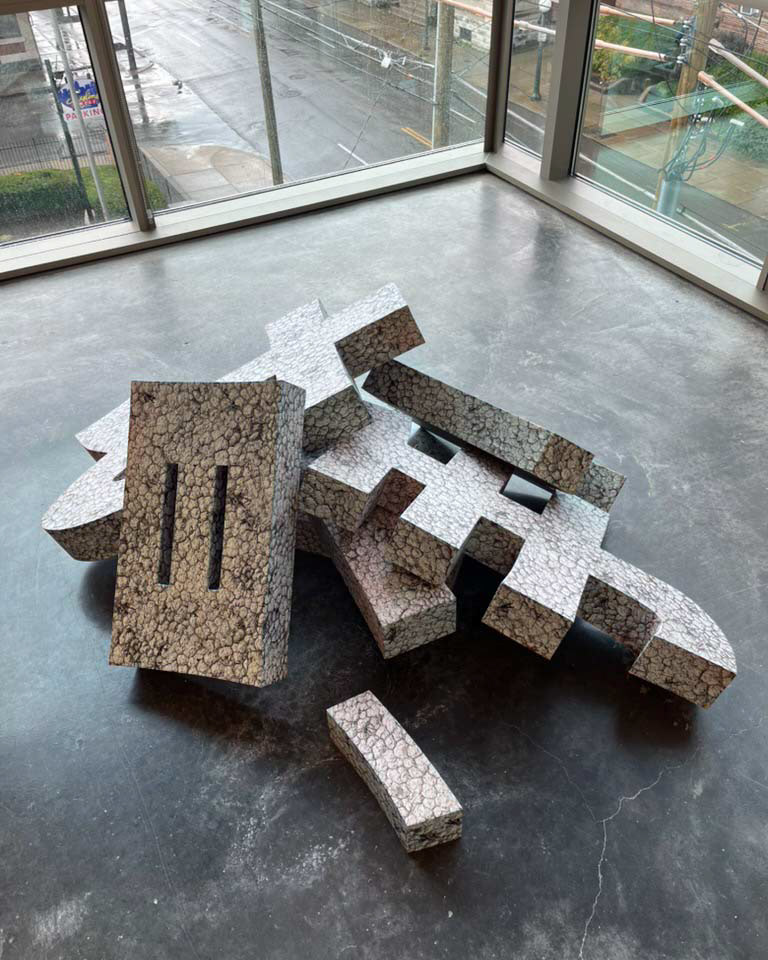
我慢 Gaman, Emotional Endurance, 2024
Most Americans originate from distant lands, whether it's our own personal history or that of our forebears. My family departed Japan a century ago, yet the longing for language and place is imbedded in our lives. Mother Tongue integrates traditional Japanese language with contemporary American landscapes, illuminating a diasporic middle ground which is rarely discussed.
I began to dissect family history through language. Take, for instance, the word "migration," is written as 移住 in Japanese. The characters breakdown as follows: 移 signifies "shift," "move," or "change," while 住 denotes "reside," "live," or "inhabit." It is beautiful to understand the word “migration” as the “shifting residence” or “changing lives.”
I also use the Japanese characters and their radicals to breakdown words to their fundamental components. If you dig deeper, 住 can be dissected into its constituent parts: 人 meaning "human," 化 representing "change" or "becoming," and 王 signifying "sovereign" or "monarch." The connection between character radicals and the meaning of the word is symbolic, but also resonates with real-life experiences of diasporic families.
These artworks take the form of photographic sculptures. The individual pieces are wrapped in photographs of American landscapes, which share characteristics of Japan. Rather than placing the individual characters legible to a Japanese reader, they have fallen into a mound. Unreadable. However, the imagery of the landscapes can be interpreted succinctly.
These artworks take the form of photographic sculptures. The individual pieces are wrapped in photographs of American landscapes, which share characteristics of Japan. Rather than placing the individual characters legible to a Japanese reader, they have fallen into a mound. Unreadable. However, the imagery of the landscapes can be interpreted succinctly.
The concepts conveyed by these works revolve around the deconstruction and forgetting of traditional language, contrasted with the contemporary construction of identity. Viewers will contemplate the intricacies of the artwork and relate it to their own reflections on language and place.